CU-01Current
Darter
A floating plug with a flat scoop cut at an angle across the nose. It does very little in still water and comes alive when it is swung across a moving tide on a tight line.
Entry revised on 18/07/2026
What the face does
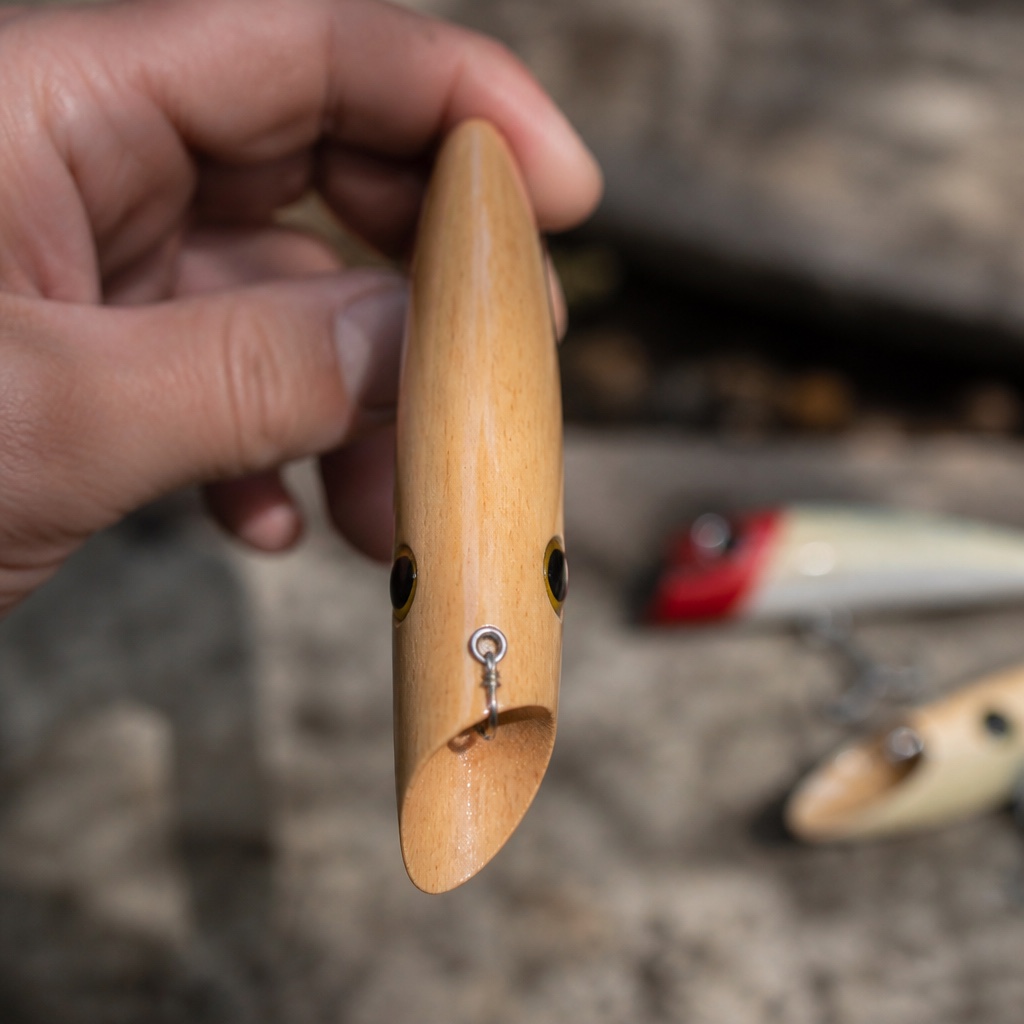
The nose of a darter is not rounded. A flat plane is cut across it at an angle, sloping back and down from the top of the head, and the line tie is set on that slope rather than on the point of the nose. Everything the plug does follows from that one cut.
Pulled forward, water presses on the angled plane and drives the head down and off to one side. The moment the plug swings, the pressure across the face changes and it dips back the other way. The path is a series of dives and sideways swings rather than the regular wobble of a metal lip swimmer, and it reads in the water like something that has lost its balance.
Because that motion is driven by water pressure alone, with no lip to correct it, the plug needs a certain speed of water across the face. Retrieved fast through still water it just planes up and skips. Held in a moving tide it works continuously without being reeled at all. It floats at rest, dives as soon as tension comes on, and rises again the instant you give it slack, which is a useful thing to be able to do when there is rock underneath you.
The swing
A darter is not cast at fish and retrieved. It is placed above moving water and allowed to travel through it while you keep contact. The sequence is always the same:
- Cast up current, or straight across it. Never down current, because the plug will never load.
- Close the bail and take up slack until you feel the plug hanging in the flow. It should feel heavy.
- Let the tide swing it across the seam, reeling only fast enough to stay in touch. The current does the work.
- Where the water is very fast, feed a little line so the plug is drifting rather than skidding on the surface.
- Expect the take at the end of the swing, as the plug straightens up below you and slows.
Where it earns its keep
Anywhere a tide is squeezed and accelerated: the rip off the end of a jetty, a breachway, an inlet mouth, a canal, the gap between two boulders, the edge of a bar where water pours through a cut. Night and low light suit it, and it wants enough depth to dive into without hitting bottom.
On an open beach it still has a use, swung along a trough when a hard side sweep is running. What it cannot do is work in dead water. If there is no current at all, this is the wrong family, and a swimming plug will do more.
Reading what the plug tells you
A darter reports the water back through the rod better than anything else in the register. Learning to read it is most of the skill.
Dead rod, plug skating on top
Either the retrieve is too fast or the cast landed too far down current. Slow the handle first, and if that fails, move up and cast again at a steeper angle.
Heavy, thumping load
The plug is digging and swinging exactly as intended. Do not speed up to make it feel busier.
Sudden lightness in mid swing
It has fallen out of the fast water into slack water behind a rock or a bar. That edge is often the best place on the whole cast; pause there and let it hang.
Common mistakes
- Fishing it like a swimmer, on a straight retrieve through still water, and concluding the plug is no good.
- Casting down current, which is the single most common reason a darter feels lifeless.
- Hanging a heavy snap or an oversized swivel on the nose, which loads the face and flattens the action. A loop knot or a light clip is enough.
- Using it in water too shallow for it to dive, so it ploughs into sand and collects weed.