CU-02Current
Needlefish
A slim tapered cylinder with no lip and almost no built in action, made hollow to float or loaded with lead to sink. What it does in the water is nearly all supplied by the current and by you.
Entry revised on 12/07/2026
What it is
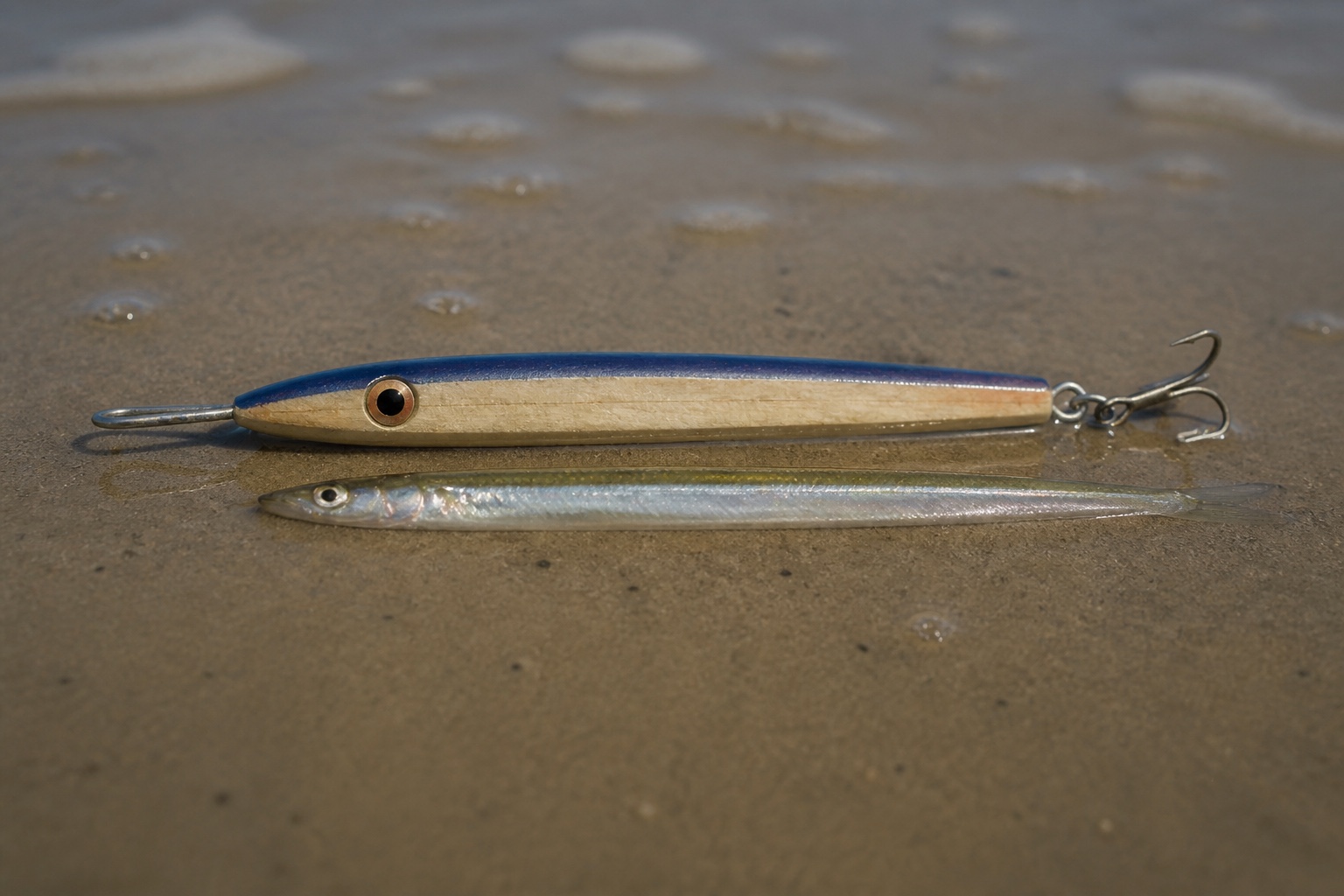
A needlefish is the plainest thing in the bag: a straight cylinder, tapered at both ends, usually round in section, occasionally flattened on the sides. There is no lip, no cup, no hinge and no scoop. Nothing on the plug forces it to move, which is exactly the point.
Two consequences follow. First, it is dense and thin for its length, so it cuts wind and casts further than almost anything else of the same weight. Second, its silhouette matches the long thin bait that dominates a great many nights: sand eels, silversides, small herring, juvenile eels. A fish that is locked on to that shape often refuses a fat profile and takes a needle without hesitating.
Floating and weighted
The same outline is built two ways, and they are not interchangeable.
- Floating or near neutral versions sit at or just under the surface. They are for shallow, snaggy water and for holding high in a fast rip where a sinking plug would be dragged into the bottom.
- Weighted versions carry lead inside the body and sink at a rate set by how much and where. They get down through moving water and stay there, which is the whole reason to own one.
It is worth marking your needles by how fast they sink rather than by what they weigh. Two plugs of the same nominal weight with different ballast behave like two different lures, and in the dark the label is the only thing you have to go on.
Fishing it
The default retrieve is slow, steady, rod tip low, and no rod work at all. At the right speed the plug rolls very slightly, and that small amount of movement is enough. Faster is almost never better.
- In current, cast across and let it swing, as you would a darter, but with a looser hand, since there is no face to load.
- Long slow sweeps of the rod make it dart and then glide. Drop the tip between sweeps and let it fall on a slack line, which is when most takes happen.
- In deeper water, count it down after the cast and change the count until you find the level the fish are holding at. Write the count that worked on the back of your hand if you have to.
- When a swimmer has blown out and a darter is digging into the bottom, this is usually the plug that still works.
Where it earns its keep
Strong current, clear water, calm nights, and any time the bait is small and thin. Inlets and canals on a hard tide, the deep side of a bar, the wash along a rock face, and open beaches in a headwind when the only thing that matters is reaching the fish. It is the least dramatic plug in the register and often the most consistent.
Rigging and upkeep
Because the body is slim there is very little wood around the hardware, so a needle is a plug where through wire construction matters rather than being a nicety. A screw eye in a thin maple body is not something to trust with a large fish.
- Many anglers fish a single inline hook at the tail and nothing on the belly. It fouls the leader far less on the cast, and it makes releasing a fish quicker.
- A dressed tail hook slows the sink a little and adds a small amount of movement. On a weighted needle that can be the difference between the right depth and the bottom.
- Check the tail eye and the nose loop for wear, since the whole load of a fight passes through them.
- Rinse in fresh water and dry it before it goes back in the bag. Lead ballast inside a cracked body is the fastest way to a plug that fills up and swims dead.